Hannah Harding, patent paralegal at Page White Farrer, writes:
On Thursday 18th June the IP Inclusive Business Support Professionals working group launched their very first in-person event with Networking: The Theory and the Practice for Business Support Professionals – a talk and Q&A around the topic of networking, an often overlooked area for those in support roles.
Kindly hosted by Mewburn Ellis at their London office, even the rather lovely view of the Thames and Tower Bridge proved insufficient to distract the attendees from the talk delivered by Michael Evans of BDforIP and Meera Taank of Taank IP.
Networking theory
Knowing what networking is, and even more crucially what it isn’t, proved a good starting point. Networking is not the sales meeting and performative environment that most people envision, and is at its heart nothing more or less than a conversation between human beings. The importance of networking as a skill for those in support roles was covered in some detail, noting it is a chance to develop relationships outside of your immediate colleagues and to build a personal support network, an opportunity to meet others with similar experiences to bounce ideas off (for example, someone undertaking the same qualification as you), and can even be useful for finding potential new members for your team or a new role for yourself.
Networking is something to be approached with patience, and the idea that a connection made may not prove useful until potentially years down the line. This was encapsulated wonderfully with the phrase “Building bridges you do not as yet need to cross”.
Networking practice
So now attendees had the theory, but how to go about putting that theory into practice?
Michael and Meera had excellent practical advice to give, notably to take the pressure off by treating it as general conversation about anything rather than something to rehearse or perform. Conversation can be kept light and can (and arguably should) venture into non-work topics such as hobbies and family. Potentially contentious topics such as politics or religion are best avoided.
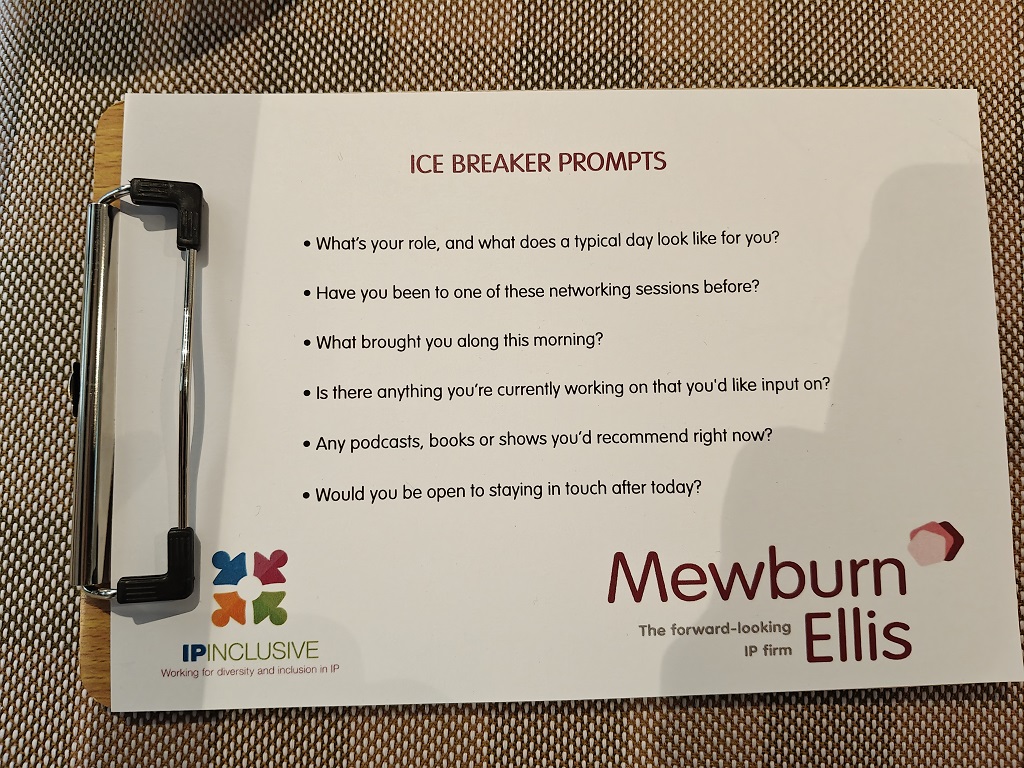
Having a few useful questions to ask in any networking situation was a tip with more than one positive – not only does this break the ice, but it also takes the pressure off you to talk and allows you to listen to the answers! Some suggestions included:
- “What did you think of the talk?”
- “Do you come to many IP Inclusive events?”
- “What prompted you to come to this event?”
- “How far have you travelled to get here?”
A discussion around overthinking ahead of potential interactions yielded some key points to remember – that everyone, no matter their level of experience, gets nervous and experiences impostor syndrome; and that most people worry too much about being interesting where it is equally if not more important to be interested in what the other person has to say. Suggestions of potential ways to combat these omnipresent worries included having a mantra to say to yourself, or a song to play ahead of the event (Iron Maiden’s Run to the Hills is a purely coincidental choice, I promise!), or to look out for ways to contribute to the event itself for example being a speaker or chairing a panel) to make things a little easier.
Events
All set with the theory and the practice, but now attendees needed to know how to go about finding events to attend try out their new skills!
Straightforward tips shared included asking others at events you attend about the the sort of events they like to attend, signing up for event lists and newsletters (our IP Inclusive one is here – see what I did there?), and searching for event topics on Eventbrite.
It’s also good to know how best to follow up after an event with people you meet. Making notes or a voice note on your phone so you don’t forget key impressions, or the names and firms of those you spoke to was a good start, but it was also recommended to send a short email (or failing that, a message on LinkedIn) with a note.
A question was raised about attending events which are not specifically aimed at those in support roles where most of the attendees will be qualified attorneys. Whilst acknowledged that this can be intimidating, it was recommended that if you are genuinely interested in a topic you should try to go, and if possible take a buddy with you, be it a colleague or someone you’ve met at a previous event. It was noted that the numbers of non-attorneys attending events is slowly growing, so you are unlikely to be on your own.
Whilst important to try to prioritise meeting and making connections in person wherever possible, using LinkedIn effectively also has its place. If you can’t meet in person and want to connect with someone, the key thing to remember is to include a message about how that person has come to your attention (for example you’ve read and enjoyed an article they’ve written). Having something in addition to the request to connect helps avoid your message looking like an unwanted cold approach.
Support
There was fruitful discussion about how to encourage firms to support event attendance for their staff. Some key factors highlighted for making the case included:
- The vast majority of events are free to attend. If you are looking to attend an event which isn’t free, it is worth finding out if you can contribute as mentioned earlier in order to waive the cost.
- You can offer to make notes and bring back information to share with other staff.
- IP Inclusive events can count towards paralegal CPC/CPD for CIPA and CITMA, which is a requirement for paralegal membership.
- Attending helps to raise the firm’s profile through you representing them.
The session ended with a chance for attendees to put all they had learned into practice and mingle over breakfast.