In early August 2026, to mark South Asian Heritage Month, IP & ME held an informal social get-together at a Lancelot Ribeiro retrospective at Swiss Cottage Library. Committee members Beatrice Malacart (Forresters) and Mary Iyi (MVF) have kindly written us this piece about their experiences of the exhibition.
IP & ME will continue to explore the South Asian heritage theme in an upcoming webinar with Rina Sond. They also hope to run an event to mark Black History Month in October. Keep an eye on the IP & ME webpage for more details and sign-up links.
Beatrice and Mary write:
Introduction
South Asian Heritage Month celebrates and raises awareness of the histories, cultures and contributions of South Asian communities. This year’s theme, “Unity in Diversity”, highlights the range of cultures, languages, faiths and histories across South Asian nations while exploring the shared values, history and sense of community that unite them.
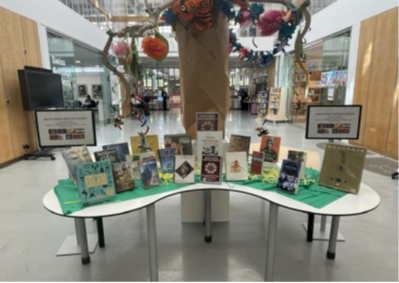
Early in August, to mark the occasion, members of IP & ME visited Lancelot Ribeiro: A Retrospective Revisited at Swiss Cottage Library in London.
Lancelot Ribeiro’s art is deeply shaped by his personal story of migration and his experiences across different cultures. These elements resonate strongly with this year’s South Asian Heritage Month theme, making the exhibition a perfect opportunity to celebrate the artist’s contribution to British South Asian artistic heritage.
The Artist
Lancelot Ribeiro (1933-2010) was an Indian-born artist from a Goan Catholic family. In 1950, he followed his brother, painter F. N. Souza, to London to study accountancy, but soon abandoned it to pursue his creative interests, studying life drawing at St Martin’s School of Art. Ribeiro later returned to India, where he established himself as a full-time artist, before moving permanently to London. In 1963, he co-founded the Indian Painters Collective, supporting Indian artists in Britain.
Ribeiro’s art is bold, expressive and experimental. While his early work was influenced by Goan landscapes and architecture, it became increasingly colourful and abstract over the course of his career, characterised by his pioneering use of synthetic materials. His background and experiences of moving between India and Britain are reflected throughout his work.
The Exhibition
The exhibition was held in the same venue that hosted Ribeiro’s landmark retrospective in 1987, bringing his work back to Camden nearly four decades later. It offered residents and visitors a renewed opportunity to engage with his art and reflect on his enduring artistic legacy.
Retrospective Revisited brought together selected works from Ribeiro’s remarkable career, exploring themes of migration, identity, memory and belonging across cultures. Alongside his artworks, the exhibition also featured some of the tools of his creative practice, including his brushes, paints and other materials. Seeing these personal objects alongside the finished pieces provided an additional insight into the artist behind the work and the process through which his ideas were brought to life.
South Asian Heritage Month – Unity in Diversity
Members of IP & ME who attended the exhibition were deeply impressed by Ribeiro’s work. As we reflected on what we had seen, the exhibition prompted us to think more broadly about this year’s South Asian Heritage Month theme. Although our individual backgrounds, cultures and experiences may be diverse, art has a unique ability to unite us. It allows us to encounter experiences different from our own while also recognising emotions, ideas and questions that we share.
Ribeiro’s work demonstrates the richness that can emerge when different cultures, identities and perspectives are given space to be expressed. Through celebrating diversity, we give ourselves the opportunity to experience the extraordinary breadth of creativity, history and knowledge found across our communities. The exhibition was also a reminder that inclusion is about more than recognising difference. It is about creating environments in which people from different backgrounds are able to contribute, create and be seen. When diversity is welcomed and encouraged, it enriches our collective cultural landscape and opens the door to extraordinary contributions that might otherwise be overlooked.
For us, Retrospective Revisited captured the spirit of “Unity in Diversity” beautifully. Ribeiro’s work crosses cultures, generations and experiences, reminding us that our differences do not have to divide us. Instead, they can broaden our understanding of one another, strengthen our connections and contribute to a richer shared story.