On Tuesday 10 March CIPA and IP Inclusive came together to celebrate International Women’s Day and Neurodiversity Celebration week with a seminar on Behind the Mask: Neurodivergent women in IP. The panel featured IP paralegal Hannah Harding, from Page White Farer, Women in IP and IP Ability committee member Cassandra HiIl from Mishcon de Reya, former CIPA president Dr Alicia Instone from Cleveland Scott York, Neurodiversity consultant Emma Marfé, and IP paralegal Eleanor Salton from Kilburn & Strode. The discussion was chaired by Caelia Bryn-Jacobsen from Kilburn & Strode, who is a member of IP Ability, the IP Inclusive Advisory Board and CIPA council. It was kindly hosted by Kilburn & Strode in their London office.
What is masking?
The discussion started with an exploration of what masking is and is not. It is not the everyday efforts we make to look our best like shaving or combing our hair. Masking was described as hiding and suppressing natural traits in a continuous editing of self, a real neurological burden. Those traits might be physical like stimming (repetitive physical movements, sounds, or actions), or behavioural, like needing to be alone after a period of being with others. Whatever form neurodivergent traits take, constantly suppressing your natural behaviour and trying to present yourself differently, on top of doing the day job, is neurologically exhausting.
Experiences of masking
Asked what their experiences of masking were, many of the panel described seeking a diagnosis as adults. Neurodivergence has for a long time been misdiagnosed and under-diagnosed in women because historically research was based on male experiences. For these panellists then it was a revelation that other people had similar experiences, and masking was deeply ingrained in their behaviour as they tried to fit in with social norms. Masking can create an iceberg effect; whilst on the surface all you see is the tip that is a person conforming to societal norms, underneath there is a huge amount of effort going into creating that appearance, which is why it is so exhausting. Another panellist described it as incredibly intense, constant, multitasking. In fact, masking can present as very high competence, but it hides the exhaustion behind it and increases the risk of burn out.
Masking can change over time as well, with one panellist noting that her traits were more prominent in childhood, but she masked more as an adult, and another mentioning that with the onset of perimenopause, her coping mechanisms deteriorated. This has compelled her to focus on what she needs, so rather than masking constantly for three-day events and being exhausted at the end of it, she factors in downtime and rest days.
Why does masking happen?
IP is a profession that appeals to, and is stronger for, many neurodivergent traits, such as big picture thinking, deep focus, pattern spotting, and critical thinking. Whilst the landscape is gradually changing, the IP professions also remain male dominated in areas. Furthermore, as with the legal sector more widely, expectations of professionalism are strongly traditional. In an area that calls to a neurodiverse mind, there is a neurotypical expectation. Women therefore feel the need to “change” to prove themselves, and conform to neurotypical norms, which may result in them masking as a coping strategy, or not seeking the support they need to cope and be able to perform their job to the best of their abilities. The situation is compounded because it is harder to break taboos and overcome stigma in a conservative profession. Neurodiverse women trying to prove themselves in a male dominated traditional world don’t want to appear “weird or odd”, or stand out by complaining about the bright lights or noisy office, or seem uncommitted by avoiding day long events with evening networking that will drain them. So instead, they mask, they conform, and they leave themselves exhausted by the effort.
What organisational and individual changes can reduce masking?
Organisational
Many of the support mechanisms that offices put in places are reactive. Where possible, it is better to go back to the work environment and start by consulting the people who will work there. In fact, psychological safety and communication came up as themes throughout this discussion. For many neurodivergent people, more clarity in communication would help, whether that is: understanding what people’s needs are; understanding what their roles are; checking if I said what I want to say, or was there an underlying message I haven’t said out loud; agendas for meetings; checking that people are doing ok; communicating that it’s ok to take downtime after or during an event. This conversation should be ongoing and revisited regularly as needs change over time. Together, organisations can drive neuro-affirming workplaces; and for this buy in at every level, with management endorsement, is key.
It is important to note that many of these small changes will help everyone in the office, not just those who are neurodiverse. Nobody needs to know what anyone else’s diagnosis is, or whether they have one – just what a person needs to do their job to the best of their ability and to thrive in the workplace.
Individuals
Self-care is a marathon not a sprint. One panellist described “micro-boundaries” – the idea of changing one small thing at a time to protect yourself, such as going to a quiet room after a long meeting. Keep doing that one small change every time until it becomes the norm for you, then introduce another change. Unmasking is not a “Ta Dah!” moment, but a process.
No two neurodivergent people are alike, so be open to learning more about what other people need. If there isn’t one already, set up a support network in your office so you can find out more, share resources and not feel alone.
What do you want a woman in IP who is masking to hear?
The panel discussion ended with some powerful messages from the panel, who were all comfortable to speak openly about their neurodivergent experience in the workplace, to someone who is still masking and does not feel able to be their authentic self at work.
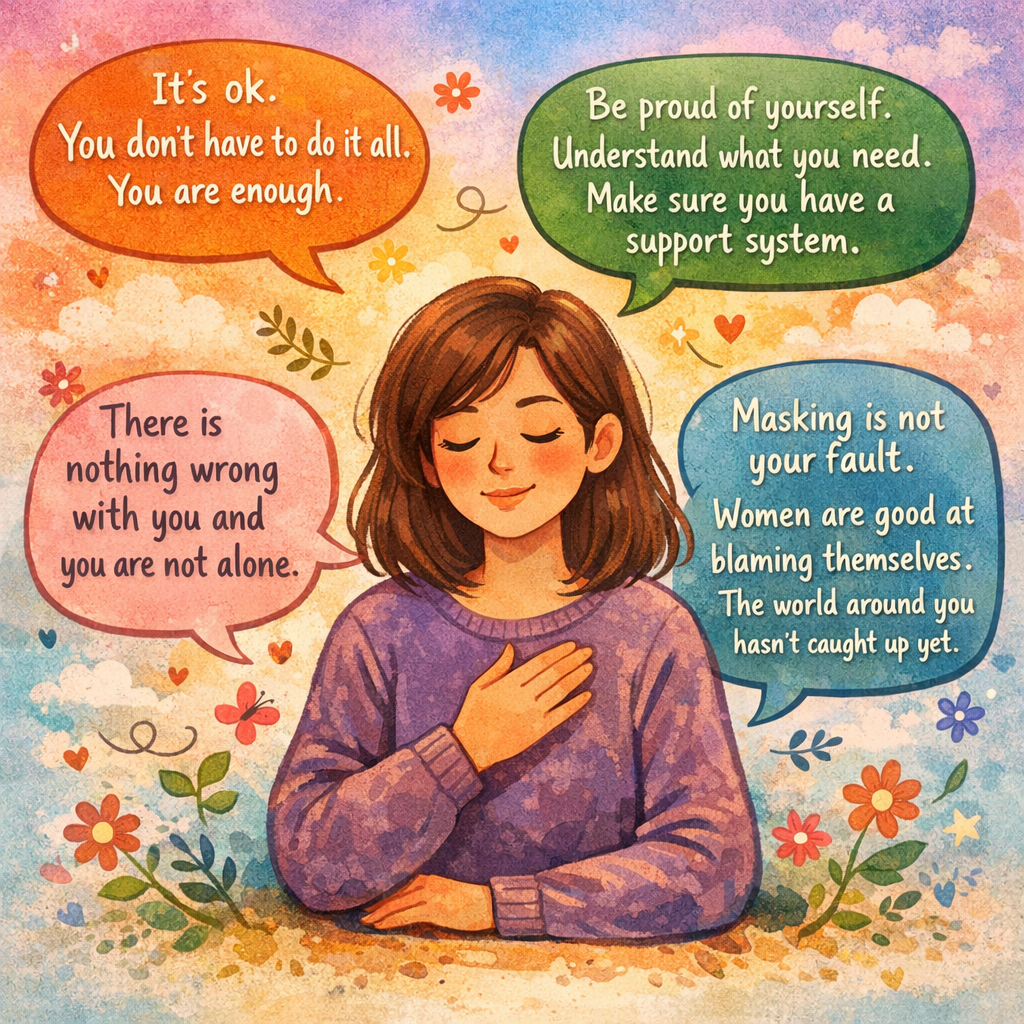
Image description: A drawing of a peaceful looking woman surrounded by flowers and speech bubbles. The speech bubbles read “It’s ok. You don’t have to do it all. You are enough.” “Be proud of yourself. Understand what you need. Make sure you have a support system.” “There is nothing wrong with you and you are not alone.” “Masking is not your fault. Women are good at blaming themselves. The world around you hasn’t caught up yet.”
Page published on 21st April 2026
Page last modified on