This guest post by Victoria Barker and Kathryn Sayer is based on a joint talk they gave at CIPA’s Pre-Congress Drinks Reception in September 2026. The talk was incredibly well received and we are grateful to them for sharing their thoughts with a wider audience.
Victoria and Kathryn write:
Accentism, or accent bias, occurs when assumptions are made about a person because of the way they speak. An accent may reveal, or appear to reveal, something about geographical or social background. The problem arises when listeners extrapolate from it and make unrelated judgements about intelligence, competence, honesty and/or professionalism. When we volunteered to speak about accentism at the CIPA Congress EDI Drinks Reception, the subject was personal to both of us as we have both been subject to such hurtful assumptions.
Accent is not explicitly protected under the Equality Act 2010. However, accent bias may overlap with, and reinforce, inequalities associated with social class, ethnicity, and geographical background.
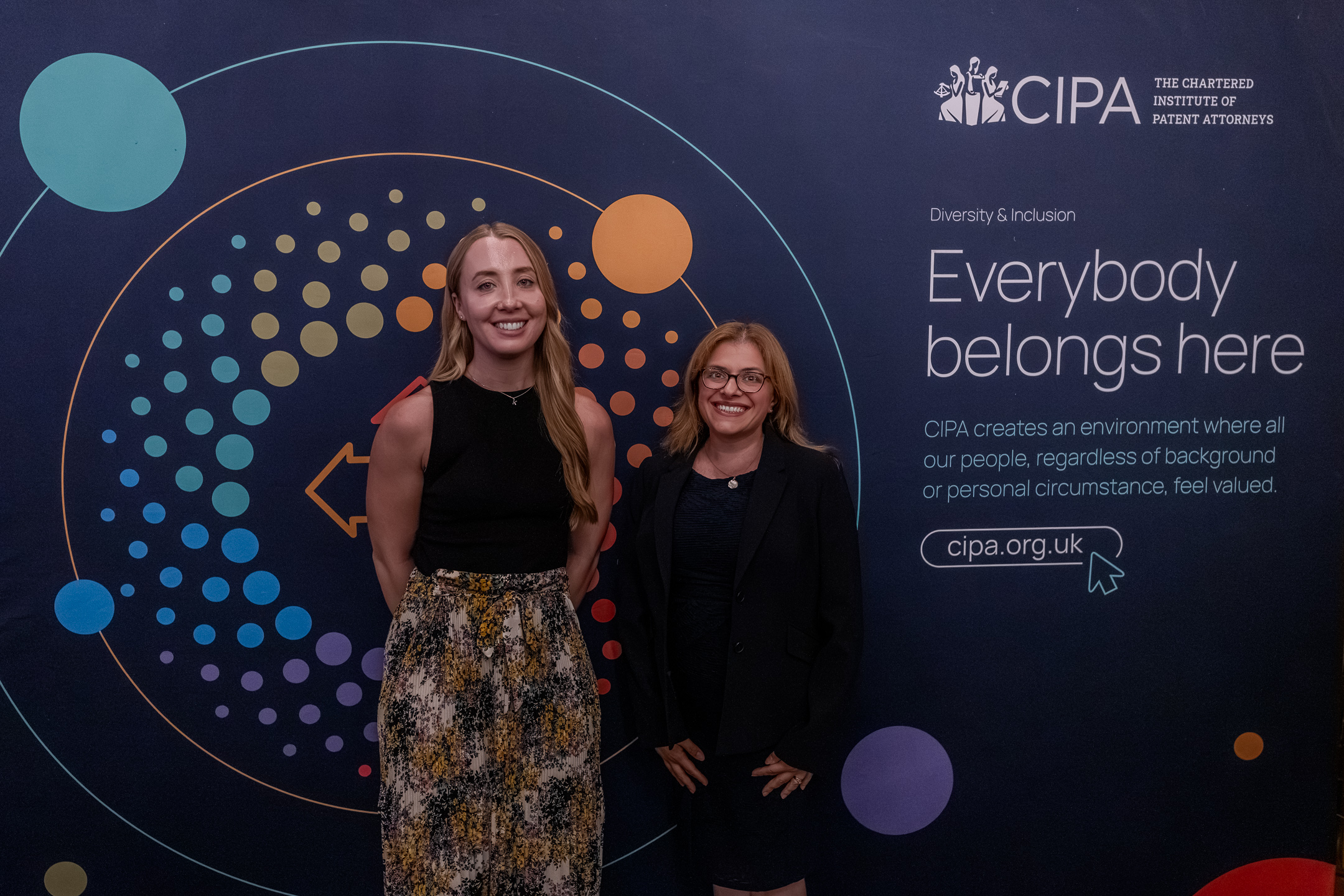
Kathryn & Victoria at the reception
Why this matters in the patent profession
The patent profession is highly academic and places considerable emphasis on precise communication. Patent attorneys must establish credibility with clients, explain complex technical and legal issues, and advocate effectively in hearings and oral proceedings. This can create an expectation that a capable professional will present, and sound, a particular way.
Recent research into accent bias at the Bar illustrates the problem [1]. Participants listened to the same legal argument delivered in different English accents. Speakers using Received Pronunciation (RP) or South-East English accents were rated highly for professionalism, intelligence and confidence. The West Midlands accent received the lowest ratings overall. More than 80% of participants said they would be comfortable being represented by the RP or South-East speakers, compared with fewer than 20% for the West Midlands or South-West speakers.
Although the study focused on advocacy at the Bar, its findings are relevant to patent attorneys too. Our work depends on the substance and precision of our words, but listeners may still allow the sound of those words to influence their assessment of the speaker. A regional accent does not indicate poor language skills, any more than an RP accent guarantees expertise. Yet people who do not sound like the traditional stereotype of an intellectual or legal professional may feel that they must work harder to demonstrate that they belong.
When comments leave a lasting mark
For many people, these judgements do not begin in the workplace; they accumulate over years. Katy first remembers her accent being mocked when she was about ten. Later, while interviewing to study mechanical engineering, she became acutely conscious that she was one of the few candidates with a regional English accent. At university, people repeatedly asked her to perform stereotypically Scouse phrases for their amusement.
The experience that affected her most came when a senior professor praised the quality of her written work but added: “As soon as you open your mouth it just spoils it for me.” At 22, Katy did not feel confident enough to challenge him. Instead, part of her internalised the criticism. When she began applying for jobs, her accent had become one of her greatest insecurities.
Vicki’s experience was different but led to a similar response. Her Potteries accent was stronger when she was younger, but she consciously diluted it following hurtful comments. She began avoiding regional expressions and words that made her pronunciation particularly noticeable.
Local speech can also be connected to identity. Greater mobility and mass media may be contributing to highly localised accents and dialect words being replaced by broader regional “super-accents”. In the Potteries, for example, “duck” remains a familiar term of endearment, while the more localised “shug” (used by Vicki’s Nan) is much less well known, even in Stoke. When people feel compelled to soften or abandon distinctive ways of speaking, something culturally valuable may be lost as well.
Accent bias is not always expressed negatively. Certain accents may be stereotyped as especially friendly, reassuring or authoritative. But even apparently positive assumptions are still stereotypes: they assign characteristics to someone before that person has had the opportunity to show who they are.
Changing how we listen
The solution is not to tell people with regional, working class, or otherwise less prestigious accents to speak differently. It is to change how all of us listen.
That begins with recognising that accent-based jokes and requests to “say something in your accent” may not be harmless. If somebody is mocked and does not feel able to respond, an ally can intervene with a simple comment such as, “That isn’t funny,” or “Please don’t make comments about how they speak.” A moment of awkwardness is a small price to pay for challenging behaviour that may otherwise continue.
Organisations can also take practical steps:
- Recruitment and promotion decisions should be based on clearly defined skills rather than subjective ideas of “polish” or “fit”.
- Interviewers and assessors should be alert to whether comments about “communication style”, “polish” or “gravitas” are really comments about accent.
- Those leading meetings should introduce colleagues in a way that establishes their role and expertise. When Katy was a trainee, a senior colleague made a point of mentioning her technical degree and job title when introducing her to new clients. It was a small change, but it helped prevent assumptions and allowed her to participate from the outset as the professional she was.
Most importantly, we should question the mental shortcuts that equate familiarity with competence, a particular form of confidence with credibility, or a prestigious accent with intelligence. There is no single accent of authority, expertise or belonging.
We cannot see accents, but we can hear them. It is time we listened more carefully.
[1] Braber, N et al, ‘Is he a barrister or not?’: a study on perceived and actual accentism at the Bar of England and Wales. International Journal of Speech, Language and the Law, 2024, 31 (1), https://doi.org/10.1558/ijsll.25886.
(Victoria Barker is a member of the IP Inclusive Advisory Board and a co-lead of our IP Ability community.)